A note on coronavirus about the recent mail from Joanne Wright, the DVC(A).
Recall the Möbius transformation, and note that is is unique up to scaling for \lambda > 0. w = \frac{az+b}{cz+d} = \frac{\lambda az+\lambda b}{\lambda cz+\lambda d}
Remark: Any map from the inside of a (upper half) half-plane to the inside of a circle has the form w = e^{-i\alpha} \frac{z-z_0}{z-z_0}\quad \text{ for some }\alpha \in \mathbb R, z_0 \in \mathbb C, \operatorname{Im} z_0 > 0.
B.C. 103 (8Ed 104)
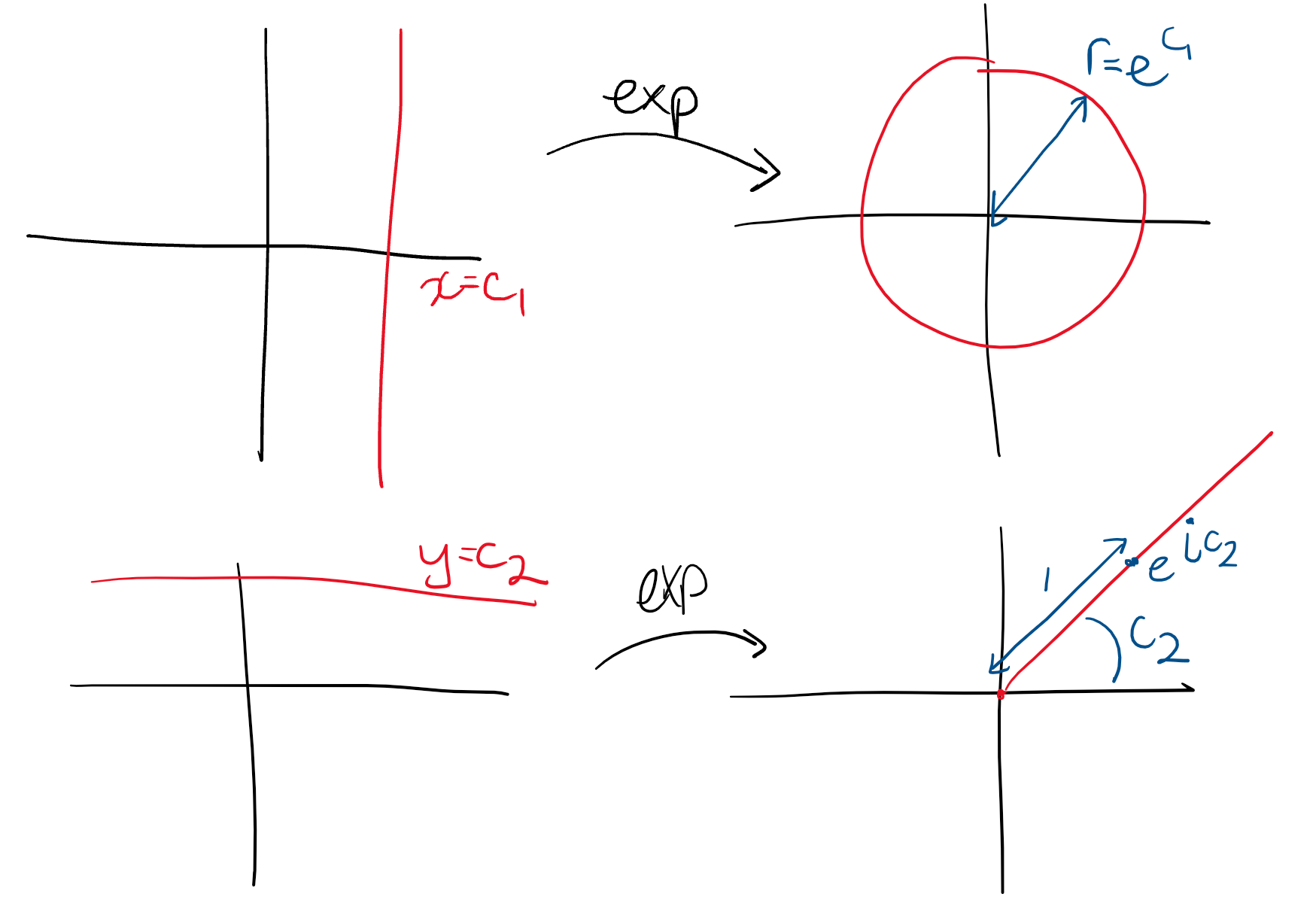
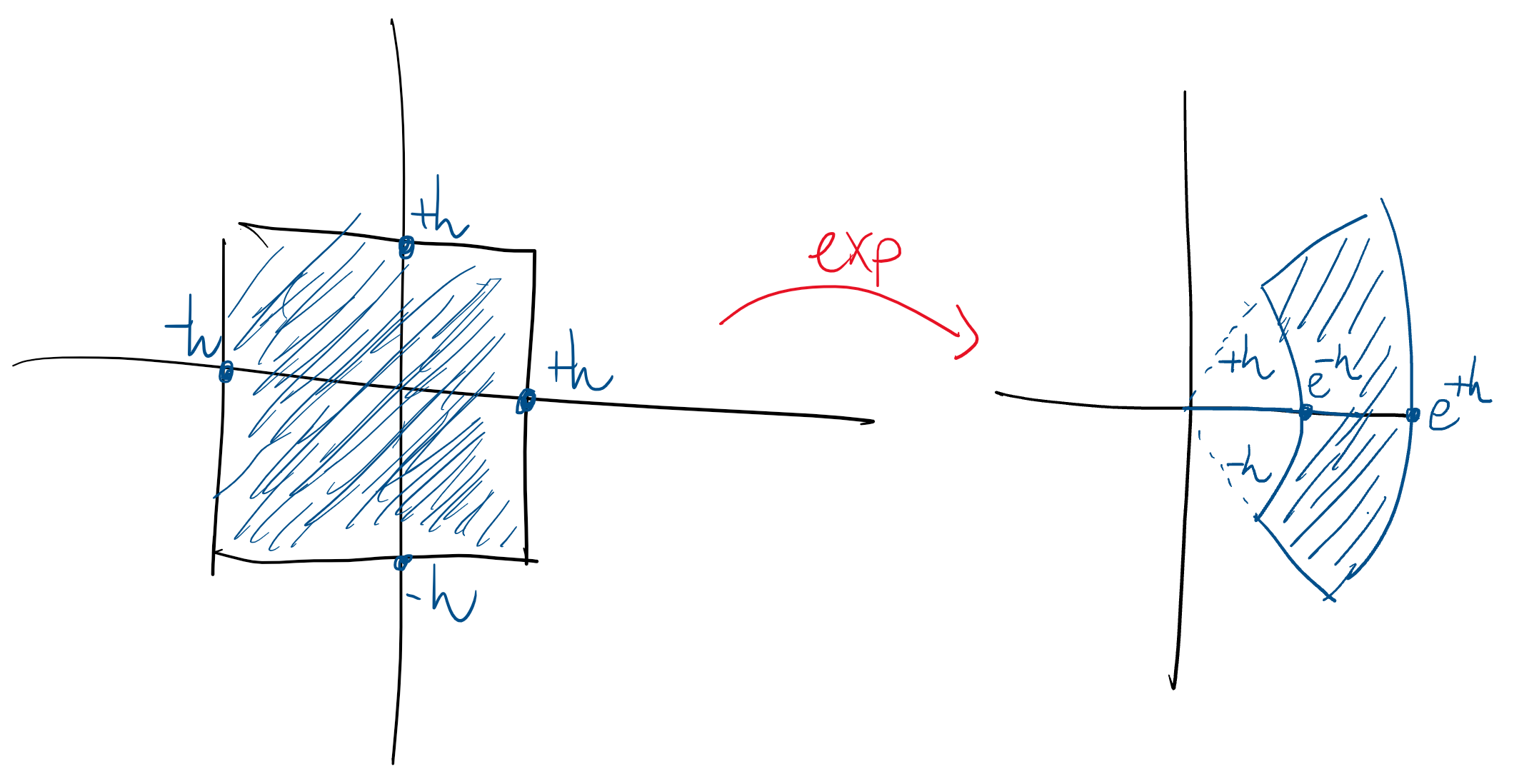
z \mapsto e^z = \exp x = w, \quad \operatorname{dom} w = \mathbb C. Given a z = x+iy for x, y \in \mathbb R, w = e^z = e^{x+iy} = e^x e^{iy} = e^x (\cos y + i \sin y) = u+iv\\[0.7em] \begin{aligned} \text{ where }\quad u &= e^x \cos y\\ v &= e^x \sin y. \end{aligned} This is easier to see by writing w = \rho e^{i\phi} where \rho = e^x, \phi = y + 2k\pi for k \in \mathbb Z. This function is periodic in \mathbb C.
Many of the properties of the real \exp extend to \mathbb C. Such as - e^0 = 1. - e^{-z} = 1/e^z. - e^{z_1+z_2} = e^{z_1}e^{z_2}. - e^{z_1-z_2} = e^{z_1}/e^{z_2}. - (e^{z_1})^{z_2} = e^{z_1z_2}.
However, some things do not extend: - e^x > 0~\forall x \in \mathbb R but, for example, e^{i\phi} = -1. - x \mapsto e^x is monotone increasing for x \in \mathbb R but z \mapsto e^z is periodic with period 2\pi i.
Note: As in \mathbb R, e^z = 0 has no solution in \mathbb C. If there was some z = x+iy such that e^z = 0, then e^x e^{iy} = 0 \implies e^x = 0 because |e^{iy}| = 1, contradiction.
B.C. 31-33 (8Ed 30-32)
We have a function f : \Omega \to \mathbb C. Then, g : \operatorname{Range}f \to \Omega is an inverse of f if g \circ f : \Omega \to \Omega is the identity. That is, (g \circ f)(z) = z for all z \in \Omega.
Example: z \mapsto z+1 and z \mapsto z-1 are inverses for \mathbb C \to \mathbb C. z \mapsto 1/z is its own inverse \mathbb C_* \to \mathbb C_*.